.51e59034.svg)







Tafsir is the detailed interpretation of the Quran. The main objective is to provide the context of the revelation of the Quranic verses. It clarifies the surah and verses of the divine revelation. The scholars have elaborated the knowledge of the Holy Book. The moral duty of Muslims is to learn the Quran word to word with proper meanings.
Meaning of Tafseer
The word “Tefseer” is derived from the Arabic word ”fassara” meaning “to elaborate” or to “interpret”. The Quranic verses are discussed with proper historical and situational context. The tafsir meaning is to explain the meaning of the Quranic verses. It helps the Muslims to understand the Quran word to word.
Why you must learn the tafseer quran online?
The main purpose is the linguistic clarification and grammatical explanation of the Quranic verses. The metaphorical and literal meanings of ambiguous verses are differentiated. It has detailed juristic discussions related to the verses of the Quran Al Karim. You can also take the Quran online courses to increase your knowledge.
Famous Works of tefseer
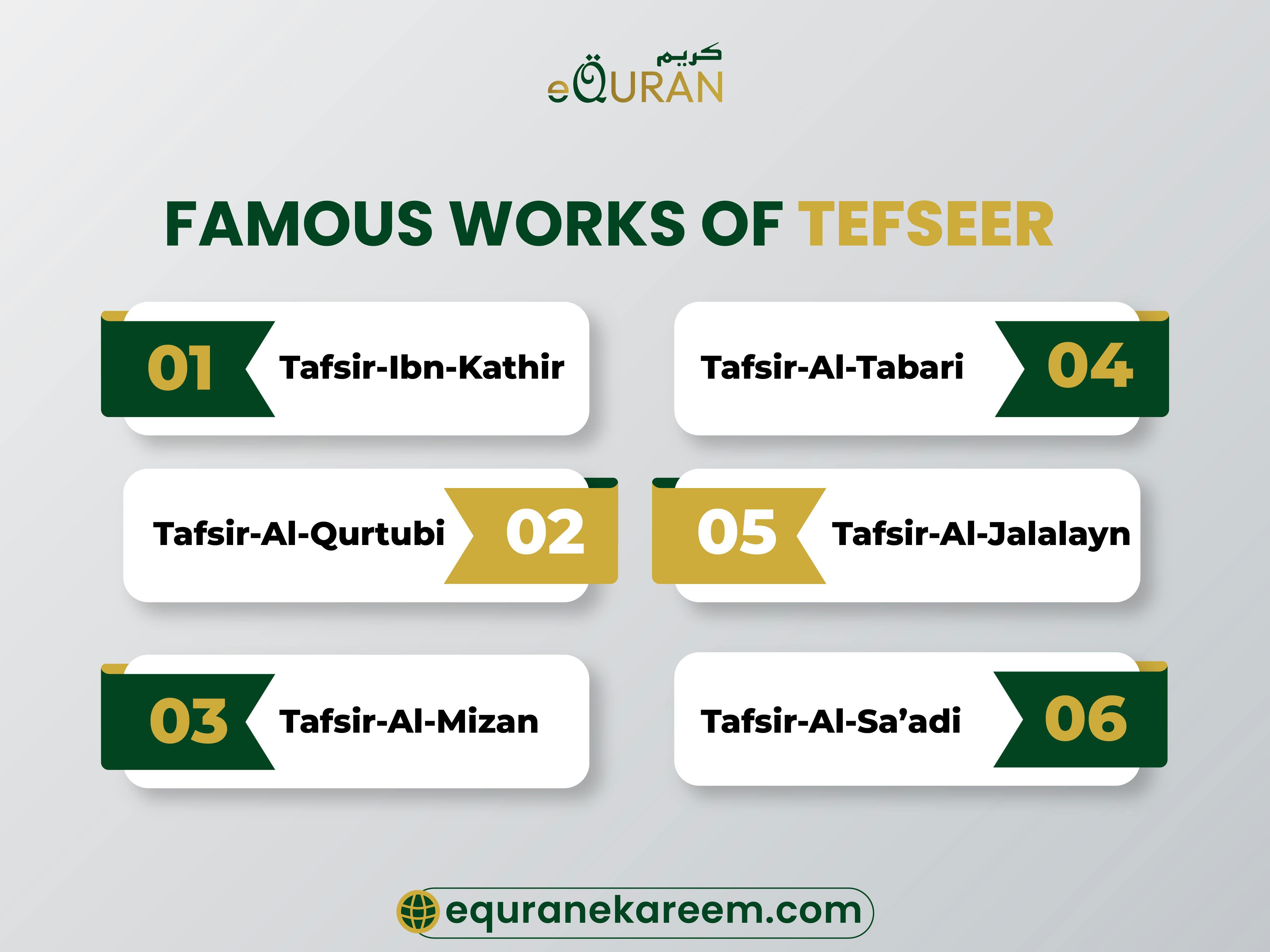
There are six important works of Tefseer. Numerous Islamic Scholars have worked on it. Other scholars have also introduced it in Urdu. Their work is highly respected worldwide.
Tafsir-Ibn-Kathir
Ismail-Ibn-Umar-Ibn-Kathir was a great Islamic scholar of the 14th Century. He provides in-depth analysis and details of verses. It is divided into ten volumes. The reader gets a concrete knowledge of the meaning of the Quranic texts. Everything is explained under the light of hadith and the historical background of the revelation
Features | Description |
Period | 1301-1373 CE |
Language | Arabic |
Methodology | Fiqh by Transmission |
Key Characteristics | Heavy reliance on Hadith and sayings of Sahabah, historical context, conciseness, and clarity. |
Focus Areas | Authenticity and transmission. Historical context and Thematic coherence |
Sources | Quran and Hadith. Sayings of Sahabah and Tabi'in. |
Linguistic Approach | Focus on classical Arabic and Grammatical explanations. |
Historical Context | Extensive use of Asbab al-Nuzul. Contextual explanations. |
Thematic Analysis | Themes of monotheism, prophethood, eschatology, and ethics. |
Juristic Focus | Some legal rulings. Not primarily focused on Fiqh. |
Spiritual and Moral Guidance | Moral and ethical conduct. Spiritual insights. |
Intended Audience | Scholars and students. General Muslim audience. |
Educational Use | Popular in educational institutions. |
Popularity and Influence | Widely respected and used. |
Tafsir-Al-Tabari
Muhammad ibn Jarir al-Tabari is a well-known Islamic teacher and scholar. This Quran tefsir is considered as the most reliable source of religious knowledge. All topics and verses are covered in great detail. They are very comprehensive, concise, and informative. The history of incidents is mentioned in great detail in the book
Features | Description |
Era | 838-923 CE |
Original Language | Arabic |
Exegetical Style | By fiqh explanation |
Core Themes | Comprehensive coverage. Historical and linguistic analysis. Use of many narrations and reports |
Primary Sources | Quran, Hadith, sayings of the Sahaba, and early Islamic scholars |
Method of Analysis | Combines linguistic, contextual, and thematic analysis |
Historical Narration | Provides detailed historical accounts and context |
Scholarly References | Extensive citations of earlier scholars and their opinions |
Audience | Scholars, students, and informed readers |
Educational Application | Used in higher Islamic education and scholarly research |
Volume Count | Originally written in 30 volumes |
Cross-References | Frequent cross-referencing within the Quran |
Narrative Techniques | Uses storytelling to illustrate points |
Accessibility | Comprehensive yet accessible to a wide range of readers |
Tafsir Al Qurtubi
This book is authored by Abu Abdullah Muhammad ibn Ahmad ibn Abi Bakr al-Qurtubi. All the laws of jurisdiction are explained with verses and references to hadiths. So, it is also called “The Collection of Legal Rulings of the Quran”. It strongly focuses on Islamic Fiqh. Islamic jurists and students consider it very informative and useful.
Features | Description |
Era | 1214-1273 CE |
Purpose | Jurisprudential |
Method | Fiqh focus |
Important features | Legal emphasis. Juristic discussions. A balanced approach to various dimensions. |
Tone | Scholarly |
Scope | Extensive |
Dialect | Classical |
Historical Context | Contextual interpretation. |
Themes | Detailed thematic focus. Legal, ethical, and moral themes. |
Utility | Practical |
Perspective | Spiritual and moral insights. Practical wisdom. |
Audience | Jurists and students of fiqh. |
Backdrop | Historical |
Examination | Philological |
Tafsir Al Jalalayn
This book is written by Jalal ad-Din al-Mahalli and Jalal ad-Din as-Suyuti. It is also called “The Exegesis of the Two Jalaals”. Everything is explained with grammatical and religious explanations. The verses of the Quran are explained under the light of hadith and fiqh. It discusses the themes and theological issues as well. The verse-by-verse commentary helps in a better understanding of the Quran
Features | Description |
Period of Composition | 1389-1459 CE (Al-Mahalli), 1445-1505 CE (As-Suyuti) |
Content Coverage | Arabic |
Methodology | Covers the entire Qur'an, providing explanations for each verse. |
Style | Concise and straightforward, making it accessible to a broad audience. |
Tone | Scholarly |
Approach | use of allegorical and metaphorical explanations |
Purpose | Make the Qur'an understandable for Muslims |
Methodology | Relies on Hadith, statements of the Sahaba, and earlier incidents. |
Popularity | Widely used by Muslims. |
Thematic Analysis | Key themes and messages. Thematic coherence |
Influence | Influential in both Sunni and broader Islamic scholarship. |
Translations | Translated into English, Urdu, Turkish, and more. |
Editions | Available in numerous print and digital editions. |
Interpretative Balance | Balances between linguistic, theological, and jurisprudential interpretations |
Reputation | Renowned for its clarity and reliability among classical and contemporary scholars |
Tafsir al Mizan
Allameh Sayyid Muhammad Husayn Tabataba'i has written this Quranic exegesis. It has twenty volumes. The focus is on linguistic, philosophical, and historical analysis of the Quranic text. There is an exceptional use of hadith and other references for the Quran interpretation of the verses. They are written in a scholarly way with in-depth details. This book provides intellectual guidance to the readers
Features | Description |
Period of Composition | 20th Century (1950s-1970s) |
Content Coverage | Covers the entire Qur'an |
Style | Analytical and philosophical |
Approach | Integrates philosophical, theological, and mystical approaches. |
Aim | Aimed to provide a comprehensive and profound understanding of the Qur'an. |
Influence | Influential in broader Islamic societies. |
Translations | Translated into several languages including English, Persian, and Urdu. |
Editions | Available in numerous print and digital editions. |
Commentary | Provides in-depth and extensive commentary on verses |
Interpretative Balance | Balances between traditional Islamic scholarship and contemporary philosophical thought. |
Reputation | Renowned for its depth, scholarly rigor, and comprehensive approach. |
Translations | Translated into English, Urdu, Turkish, and more. |
Readers | Scholars, advanced students, and those seeking an in-depth understanding of the Quran |
Pedagogical Use | Used in advanced Islamic studies, especially in seminaries and academic institutions |
Impact | Highly regarded in modern Islamic thought |
Tafsir Al Sa’adi
The writer of Al sa’adi exegesis is Sheikh Abd ar-Rahman ibn Nasir as-Sa'di. It has only one concise volume. The writer provides a simple Quran interpretation and thematic analysis of the Quranic verses. The linguistic and contextual meanings are described with words and phrases of the verses. Beginners of Quranic study consider it as very useful for enhancing their concepts. The readers get practical guidance for living their lives according to the Quran and Sunnah
Features | Description |
Compilation | 20th Century (1930s-1950s) |
Content | Covers the entire Qur'an, providing explanations for each verse |
Style | Simple, clear, and accessible language aimed at the general public. |
Approach | Focuses on practical guidance |
Objective | To make the Qur'anic teachings understandable and applicable to daily life. |
References for explanation | References classical scholars, Hadith, and earlier works |
Context | Provides a necessary historical context for a better understanding of Quranic revelations |
Fame | Widely respected in the Muslim world, especially among Muslims. |
Influence | Influential in modern Islamic educators |
Moral Guidance | Offers clear moral and spiritual lessons, easily applicable to daily life |
Reputation | Renowned for its depth, scholarly rigor, and comprehensive approach. |
Commentary | Provides concise and straightforward commentary on verses, emphasizing clear understanding. |
Educational Use | Used in mosques, schools, and by individuals for personal study and reflection |
Utilization | Popular for its accessibility and practical approach, widely used in Muslim communities |
Thoughts | Highly regarded in modern Islamic thought |
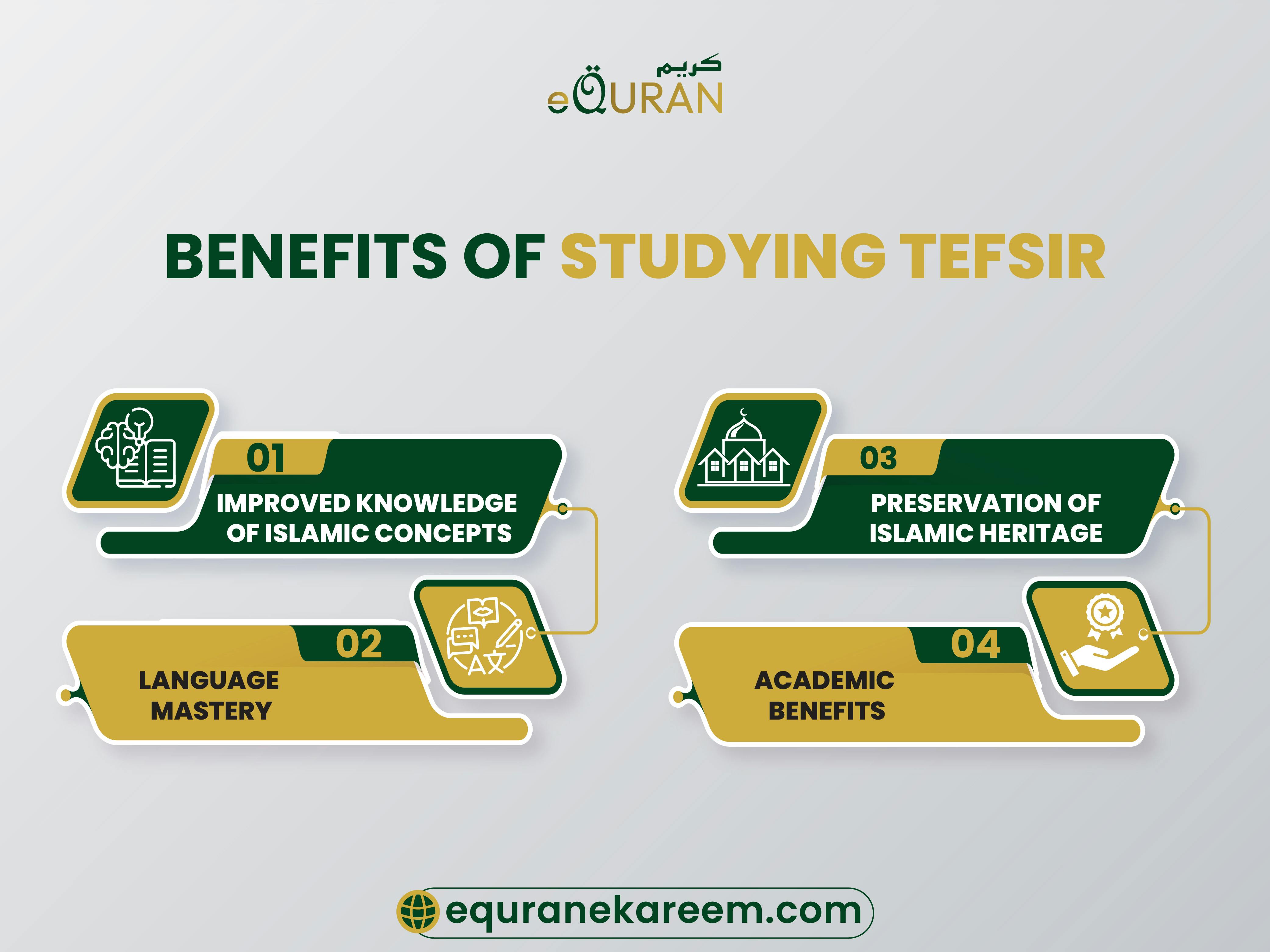
Benefits of studying Tefsir
Improved knowledge of Islamic concepts
The learning of Quranic knowledge helps in understanding the historical context of surahs. Such religious readings teach the rules of theology, law, ethics, and morality.
Language mastery
The study of Quran exegesis improves the grammar and its concepts. The readers can improve their Arabic vocabulary.
Preservation of Islamic Heritage
The study of the Tafseer Quran online helps in the cultural preservation of Muslims. The study of the Quran helps in continuing the Islamic tradition throughout generations
Academic benefits
Quranic readings improve the critical thinking of the readers. Some people also prefer the Quran tafseer in English. Studying the Quran's explanation can significantly improve the research skills of writers and senior-class students.
Join our online tafseer course
At eQuran-e-Kareem, take a Quran tefsir course along with a skilled Islamic teacher. We offer the best Quran online courses. Our professional Quran teacher will help you to study at home. Learn the Quran online and comprehend the meaning of it. Learn the best courses that will enrich your knowledge of the Quran and hadith.
Explore the life-changing experience at our online Quran academy. Our learning plan covers all the aspects of Quran learning. We have a special focus on the meanings of the verses of the Quran. Our professional teaching staff includes qualified Quran teachers. They provide the best instruction and mentorship. Allow yourself to be transformed into a scholar. Get the intellectual growth that you deserve.
Closing Words
Tefseer is a comprehensive explanation of the Quran. The main aim is to make the Quran clear to its readers. These Quranic interpretations explain the complex Arabic verses. The reasons for the revelation of verses are elucidated with facts. You can learn the interpretation of the Quran word to word. EQuran-e-Kareem offers the best Quran online courses. Seek religious education from the best Quran teachers. What are you waiting for? Enroll yourself right now!