.51e59034.svg)







“Every Soul Will Taste Death”
Are you still unaware of the methods of offering Janazah Prayer? Do you know that the “Janazah Prayer” is mandatory in Islam?
Funeral prayer in Islam is very significant and is the most common practice. This is known as “Salat-ul-Janazah” in Arabic is an obligatory prayer and is “Fard-e-Kifayah”.
For deeper knowledge about the prayer for Janaza, continue reading this informative Islamic blog!
Dua For The Deceased Transliteration and Translation
It is a practiced Sunnah to recite the dua for the dead at an Islamic funeral. To memorize this, first, you need to read it by learning the transliteration. For much understanding and quick memorizing, you should also learn its translation. The dua for deceased transliteration and translation are mentioned below
Dua For The Deceased In Arabic(For Adults - Male & Female)
اللهُـمِّ اغْفِـرْ لِحَيِّـنا وَمَيِّتِـنا وَشـاهِدِنا وَغائِبِـنا وَصَغيـرِنا وَكَبيـرِنا وَذَكَـرِنا وَأُنْثـانا . اللهُـمِّ مَنْ أَحْيَيْـتَهُ مِنّا فَأَحْيِـهِ عَلى الإِسْلام وَمَنْ تَوَفَّـيْتَهُ مِنّا فَتَوَفَّـهُ عَلى الإِيـمان اللهُـمِّ لا تَحْـرِمْنـا أَجْـرَه وَلا تُضِـلَّنا بَعْـدَه.
Dua For The Deceased Transliteration | Reference |
Allāhumma’ghfir liḥayyinā, wa mayyitinā. wa shāhidinā, wa ghā'ibinā. wa ṣaghīrinā wa kabīrinā. wa dhakarinā wa unthānā. Allāhumma man aḥyaytahu minnāfa aḥyihi `ala ‘l-Islām. wa man tawaffaytahu minnāfatawaffahu `alal-īmān. Allāhumma lā taḥrimnā ajrahwa lā tuḍillanā ba`dah. | Ibn e Majah 1/480, Ahmed 2/368, Al Albani Sahih - Ibn e Majah Muslim, 1/251 2/663 |
Dua In Funeral Prayer
The Muslims recite a dua in funeral prayer for sending blessings and mercy of Allah on the dead individual. This dua with transliteration, translation, and reference is mentioned in the following table;
Dua In Funeral Prayer
اللهُـمِّ اغْفِـرْ لَهُ وَارْحَمْـه وَعافِهِ وَاعْفُ عَنْـه وَأَكْـرِمْ نُزُلَـه وَوَسِّـعْ مُدْخَـلَه وَاغْسِلْـهُ بِالْمـاءِ وَالثَّـلْجِ وَالْبَـرَدْ وَنَقِّـهِ مِنَ الْخطـايا كَما نَـقّيْتَ الـثَّوْبَ الأَبْيَـضَ مِنَ الدَّنَـسْ وَأَبْـدِلْهُ داراً خَـيْراً مِنْ دَارِهِ وَأَهْلاً خَـيْراً مِنْ أَهْلِـهِ وَزَوْجَـاً خَـيْراً مِنْ زَوْجِهِ وَأَدْخِـلْهُ الْجَـنَّةَ وَأَعِـذْهُ مِنْ عَذَابِ القَـبْرِ [وَعَذَابِ النّـارِ].
Transliteration | Translation | Reference |
Allāhumma’ghfir lahu warḥamh. wa `āfihi, wa`fu `anh. wa akrim nuzulah. wa wassi` mudkhalah. wagh’silhu bi ‘lmā'i wath-thalji walbarad. wa naqqihi mina ‘l-khaṭāyākamā naqqaytath-thawba ‘l-abyaḍa minad-danas. wa abdilhu dāran khayran min dārih. wa ahlan khayran min ahlih. wa zawjan khayran min zawjih. wa adkhilhu ‘l-jannah. wa a`idhhu min `adhābi ‘l-qabri [wa `adhābin-nār]. | O Allah, forgive him and have mercy on him, and give him strength and pardon him. Be generous to him, and cause his entrance to be wide, and wash him with water and snow and hail. Cleanse him of his transgressions as white cloth is cleansed of stains. Give him an abode better than his home, and a family better than his family, and a wife better than his wife. Take him into Paradise, and protect him from the punishment of the grave [and from the punishment of Hell-fire]. | Sahih Muslim 2/663, Hinsul Muslim 156 |
Dua For Deceased Muslim Child
According to the Islamic Sunnah, The Prophet Muhammad(S.A.W) used to recite the specific dua for deceased Muslim child. That dua with its transliteration and translation along with the hadith reference is mentioned in the table below;
Dua For Deceased Muslim Child(Baby boy or Baby girl)
اللهُـمِّ عَبْـدُكَ وَابْنُ أَمَـتِك احْتـاجَ إِلى رَحْمَـتِك وَأَنْتَ غَنِـيٌّ عَنْ عَذابِـه إِنْ كانَ مُحْـسِناً فَزِدْ في حَسَـناتِه وَإِنْ كانَ مُسـيئاً فَتَـجاوَزْ عَنْـه.
Transliteration | Translation | Reference |
Allāhumma `abduka wabnu 'amatikiḥtāja ilā raḥmatik. wa anta ghaniyyun `an `adhābih. in kāna muḥsinan fazid fī ḥasanātih. wa in kāna musī'an fatajāwaz `anh. | O Allah, Your male slave and the child of Your female slave is in need of Your mercy, and You are not in need of his torment. If he was pious then increase his rewards and if he was a transgressor then pardon him. | Al Hakim - 1/359, Ahkamul-Jana'iz, p. 125. |
You can also download the Janazah Prayer Dua PDF to memorize and learn it offline!
Preparations Of Prayer For Janaza
Offering the prayer for Janazah is essential in Islam. It is the communal duty of the Muslims to perform Janazah when a Muslim is deceased. By this prayer, we seek forgiveness and blessings of Allah(SWT) for the dead when a Muslim dies. The offering of Janazah prayers requires some prior steps to be followed;
Getting Ready For The Janazah Prayer
When you hear about someone’s death, then it is your social responsibility to offer the Janaza prayers. The first step is to perform ablution. Then, you must follow the steps mentioned to proceed with this process.
1. Ghusl(Bath) The Deceased
Bathing the dead person is the sacred act of funeral rituals in Islam. These rituals are mentioned below;
- Check the necessary signs to confirm the death.
- According to Islam death rituals, saying “Takbeer” should be practiced after confirmation of death.
- The “ghusl death” is started at this stage. The deceased person’s body is washed by using pure water and at a pure place. The body is washed in odd numbers like 3 times or a maximum of 7 times.
- If the deceased is a man, then his bath will be done by men. And if it is a woman, then her bath is done by the females.
- The person who knows the Islamic way to give a bath to a dead person will carry on the bathing process. One or two people can accompany him/her.
- Martyrs are buried in their martyred clothes.
- The ghusl to a deceased is hidden by the people and only the person involved in this procedure will be allowed to be with the dead one while bathing.
2. Muslim Burial Shroud
- After the “Ghusl”(bathing), the deceased person is covered with clean pieces of clothes. This is known as “Shrouding or Muslim coffin”.
- Men are to be covered with three pieces of white cloth and women are to be covered with five pieces of clothes.
- The body is covered properly from head to toe and this should be done with intense care and respect.
- The color of kafan Muslim is preferred as “white” because this is referred to by Islamic Sunnah and Islam death ritual.
- The use of mild fragrances on the deceased is also included in the shrouding process.
Offering Salat al-janazah Prayer
The “Salatul Janazah” is offered after shrouding. For this purpose, Muslims take the deceased to a separate place to offer the “namaz e janaza”.
- This prayer doesn’t start with Adhaan – only an announcement is made to inform people about the offering time and venue.
- This prayer has only one Rakah and four Takbirs are offered in a single Rakah. The Prophet Muhammad(SAW) also practiced the same method.
It is narrated by Hazrat Abu Huraira (R.A.) that;
“Messanger of Allah(S.A.W) informed us about the death of An-Najash on the day when he died. Then, The Prophet(SAW) took us all to the prayer area and we aligned in rows. After this, He (P.B.U.H) said four Takbirs for the funeral prayer”.
[Sahih Al-Bukhari, Book 23, Hadith 89]
1. First Takbeer
- The “Salat al-Janazah prayer” is started by reciting the “First Takbeer” which is recited for seeking protection from the evil of Shaytan. This is done by raising hands to the earlobes and then folding down by putting the right hand over the left hand around the navel, around the chest, or not folding in some cases. These different styles are accompanied by different Muslim sects as per their individual preferences.
- Then the imam recites the Surah Fatiha. The recitation of surah Fatihah is followed by some and some recite Dua-e-Istiftah. You can recite any of these.
2. Second Takbeer
- The Imam again raises the hands to the earlobes and recites “Allah-o-Akbar”.
Reference: [Sahih Al Bukhari: Book 10, Hadith 129] - The Salatul Ibrahim(Durood-e-Ibrahimi) is recited after the second takbir is recited.
3. Third Takbeer
- The third Takbeer is recited after paying the salutations to Hazrat Muhammad(SAW).
- The dua for the dead is recited for seeking forgiveness, blessings, and mercy of Allah(SWT) at this stage.
- The Prophet Muhammad(SAW) recites multiple Islamic supplications for the dead person to seek ease and comfort for resting in peace.
4. Fourth Takbeer
- The fourth Takbeer is recited after the third one. The Imam usually takes a little pause after saying the fourth Takbeer.
- The Imam recites a dua on death for family, friends, himself, and all Muslim Ummah at this time for seeking Allah’s help to bless them all with patience and guidance during this period of grief.
- At the end of all Janazah prayer steps, all of the participants in prayer pay “Tasleem” i.e. saying ‘Assalam-o’Alykum Wa’Rehmat Allaah’. This is done the same as at the end of usual obligatory prayers.
How To Pray Janaza - Muslim Funeral Rules
Most Muslims do not know how to pray Janaza and what are the rules for the namaz Janaza(Muslim funeral prayer). For this, Islam has made some Muslim funeral rules that need to be obeyed during salatul janazah. Read the following description to know these;
- While participating in the salat al janazah prayer, it is suggested to remove the shoes to guarantee cleanliness. The place should also be pure and clean. Dirty places are forbidden for offering the prayer of Janaza.
- You can also use a clean piece of cloth for offering the funeral Muslim prayer but if you do not go for this, then make sure the place should be neat and clean.
- The absentee janazah prayer is not allowed in Islam. This means that the presence of the dead body is necessary for the Muslim Janazah.
- The salat Janaza is offered by making at least three rows. This is the Sunnah method.
- The one who missed the Janaza Namaz Takbeer can complete it after the Imam says the Tasleem(Salam). If he’d given shoulders to the dead one, then he could have completed the prayer without the supplications.
- If the child is born and then dies(fulfilling the birth process), then making Ghusl, Kafan, Takbeers, and offering Salatul Janazah funeral prayer is performed.
- If the child dies during the birth process with a chest inside then no offering of salat al janazah will be performed. With the chest outside, the Janazah is offered.
- Muslims, do not cry loudly or do acts of mourning as they are not liked by the Prophet Muhammad(SAW) and also show disobedience to Allah’s Will.
[Reference: Sahih Al Bukhari 1294, Book 23, Hadith 52, Vol 02]
Muslim Burial Steps
Some specific Muslim burial steps are followed by Muslims during the offering of Islam death prayer. These are explained in the following description;
- Burial in Islam is done after praying the funeral prayer in Islam.
- The deceased is carried to the Muslim graveyard for burial.
- The people recite Takbeer and First Qalimah while carrying the deceased.
- They also recite Islam prayers for the dead one to request Allah Pak to give peace and ease to his/her soul.
- The people follow the Muslim burial steps to fulfill the requirements of Islam.
- The dead body is covered with white clothes and is placed over the cot or stretcher.
- The Muslim burial is performed with a lot of care and respect.
- The Muslim graves are prepared according to the Muslim burial rules.
- The body is placed down in the grave with gentle care and following the Islamic funeral etiquette.
- The body is positioned in such a way that its right side faces the Qiblah. This is one of the usual Muslim funeral traditions and it is not a compulsion to be followed.
- Also, according to the customs of eastern funerals, for support of the dead body, bricks or stones are used to align it well in the grave.
- Then, the soil is used to fill the grave and this process is done gradually to avoid hurting the dead one.
- The Muslim pray for the dead at this time by reciting different verses of the Quran or supplications.
- After this, the stone, which Muslims call an Islamic gravestone is fixed at the side of the head of the buried Muslim. The gravestone in Islam is used for the remembrance of the grave so that his/her loved ones can visit the grave in the future.
- The use of expensive or fancy Muslim tombstone is forbidden in Islam.
- In the last, Islamic dua for deceased is recited again with feelings of extreme grief and soulful pain.
- Then, people sprinkle the flowers and water over the soil of the grave. These flowers are also known as the Muslim funeral flowers. This is also not a compulsory act according to Islam. It is just an Islamic tradition.
- Islam also focuses on the Muslim funeral etiquette for non Muslims. As it is one of the social rights in Islam.
Muslim Burial Time After Death
The Muslim burial time after death is not fixed but there are some particular periods at which the burial or praying janaza is strictly restricted by the Sunnah and Islamic Sharia. These time slots are mentioned below;
- At the time for sunrise until it has fully risen
- From the peak time of the sun (time of midday) until it passes over the meridian
- At the time for sunset, until it is fully set
These time slots are strictly forbidden by the Prophet Hazrat Muhammad (SAW).
[Reference: Sahih Muslim 831, Book 6, Hadith 357]
Significance Of Islamic Funeral Prayer
The Islamic funeral prayer is very significant for Muslims. The Prophet and His companions also endorse offering the pray for dead person in Islam in the congregation. This practice is deeply routed in Islamic civilization as it is part of religion as well as the responsibility of Muslims to support their Muslim brother in such tough times.
The following points show the significance of Islamic Janaza Salah;
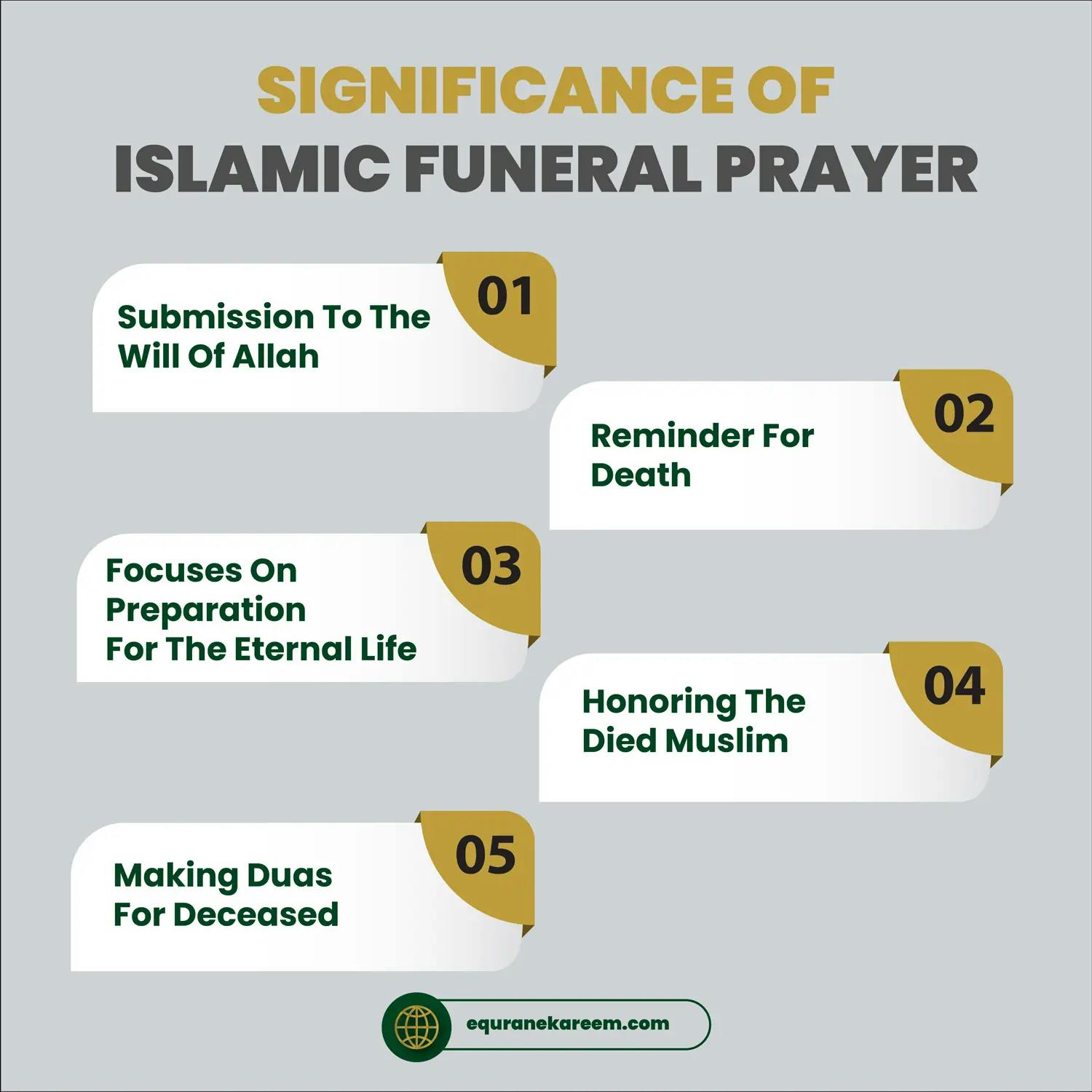
Submission To The Will Of Allah
In Islam when someone dies, it teaches a lesson to the other Muslims that “Death is a reality” and we all have to accept it with open hearts and patience. The individuals who keep patience and stay contented in the Will of Allah, are not only liked by Allah but also will be rewarded on the Day of Accountability.
Reminder For Death
A hidden lesson lies in the offering of prayers for Muslim death and that is that “death is a reminder” in daily lives. This realization is an extremely excellent source for turning someone’s sinful life into a noble and poise one. The life that is lived according to the path of Sunnah & Islam is indeed the life that a Muslim should live to be a practicing Muslim.
Focuses On Preparation For The Eternal Life
Death in Islam also reflects that we should be prepared for real(eternal) life. We have to spend much more time in that life as compared to the life on earth. The world is no more than an illusion. This worldly life is just a chance to get a better life there and to gather more and more noble deeds as much as someone can. These virtues are the luggage for good eternal life.
Honoring The Died Muslim
The death prayers in Islam are offered to pay respect and honor to the departed soul with the sense of acknowledgment that all souls will have to return back to Allah -The Most Beneficent. All the Islamic funeral procedures are performed and conducted with extreme care. Seeking salvation from hellfire, forgiveness of Allah, and blessings of Allah for the dead one is practiced for requesting Allah to grant rest and peace to that soul in the grave.
Making Duas For Deceased
The practice of making duas for deceased by the family, friends, and other associates of the Muslim society is a source for bringing rest in his/her afterlife. This dua to read for the dead brings ease and comfort to dead Muslims. The recitations are also rewarded by the Allah Almighty.
Benefits Of Offering Janaza Prayers
There are many soulful benefits of Janaza prayers that have a great impact on Muslims. The major benefits are demonstrated below;
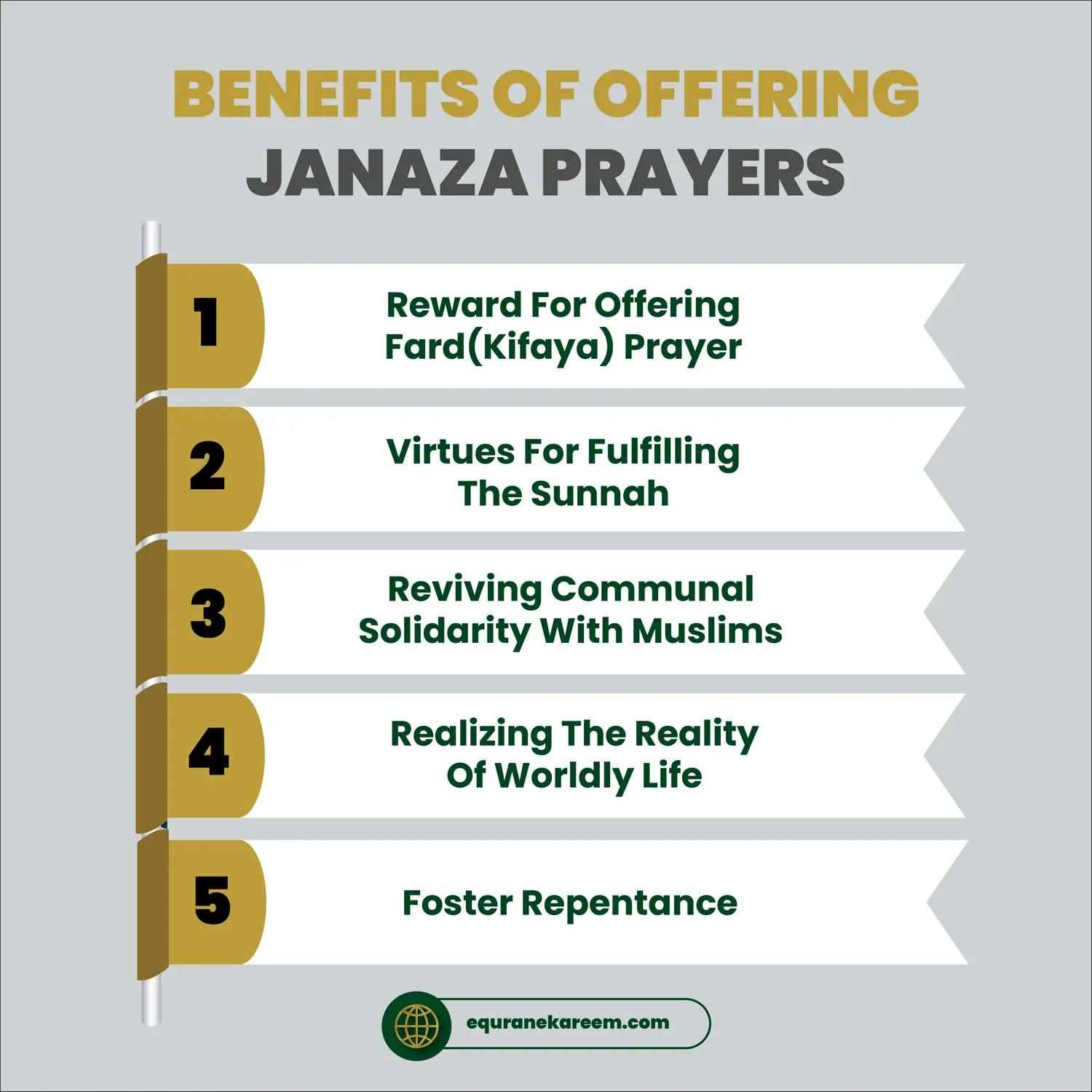
Reward For Offering Fard (Kifaya) Prayer
The offering of funeral Muslim prayer is one of the obligatory prayers(Fard-e-kafayah). Then, the reward for offering a fard prayer is granted to the one who offered it with pure intentions.
Virtues For Fulfilling The Sunnah
Janaza prayer dua is one of the commonly practiced Sunnah of the Holy Prophet(SAW). The individual will be blessed with the virtues of practicing the Sunnah by Allah(SWT).
Reviving Communal Solidarity With Muslims
The Salat Janaza is offered in congregation which shows the value of solidarity in a Muslim community. In the Muslim grieving process, communal support from the other Muslims helps give them support and calmness. This strengthens them and helps them to keep their patience.
Realizing The Reality Of Worldly Life
The death rituals Islam gradually penetrate the value of self-actualization and show the reality of worldly life. The one who implements this lesson in his/her life will be the luckiest or chosen one from Allah. Because, after getting into reality, the person with a thought of death and mortality will try his/her best to stay on the path that connects with Allah.
Foster Repentance
This common practice of Janaazah Salaah knocks the sinful souls of the Muslims who get astrayed. The Muslim funerals and burials remind them of the fact that the next one could be one of them. This hits their souls and they get back to Allah and try to avoid bad deeds and do maximum zikhar of Astaghfirullah to seek repentance from Allah.
Learn Funeral Prayer Online
Wanna learn the funeral prayers online, then join our Islamic Studies Course and Islamic Supplications Course along with the benefit of free trial classes!
Bottom Line
Attending a muslim funeral is an essential part of Islamic rules. This Muslim prayer for dead is an obligation for other Muslims to perform it. Hazrat Muhammad(SAW) said once;
“Whoever attends the funeral procession till he offers the funeral prayer for it will get a reward equal to one Qirat, and whoever accompanies it till burial will get a reward equal to two Qirats.” It was asked, “What are two Qirats?” He replied, “Like two huge mountains.”
[Sahih Al Bukhari, Chapter 23, Hadith 1325]
So, the offerings of namaz janaza are a highly rewarded deed. We tried our utmost to cover the necessary and comprehensive knowledge about all the aspects of “Muslim funeral prayer” in this blog. This will assist you in paying respect and seeking goodness for the departed souls from Allah by implementing it properly.
For more such blogs, stay tuned to eQuranekareem!